Challenging IRS Collections: How to Appeal an IRS Notice of Determination
An IRS Notice of Determination can be a frustrating experience. You were working things out with an IRS Settlement Officer when you hit a fork in the road. You believed that they were not allowing expenses on your 433-A, or you did not receive notice that they were conducting your Collection Due Process Hearing. Either way, your Appeal is now at risk of being closed and your levy sustained. Your file will now be sent back to Automated Collection System where they can possibly garnish your wages or levy your bank accounts. What can you do next?
What is a Notice of Determination?
An IRS Notice of Determination (NOD) is the final letter the IRS uses when they are closing out your Collection Due Process hearing under Section 6330 and/or 6320 of the Internal Revenue Code. They will look like this:
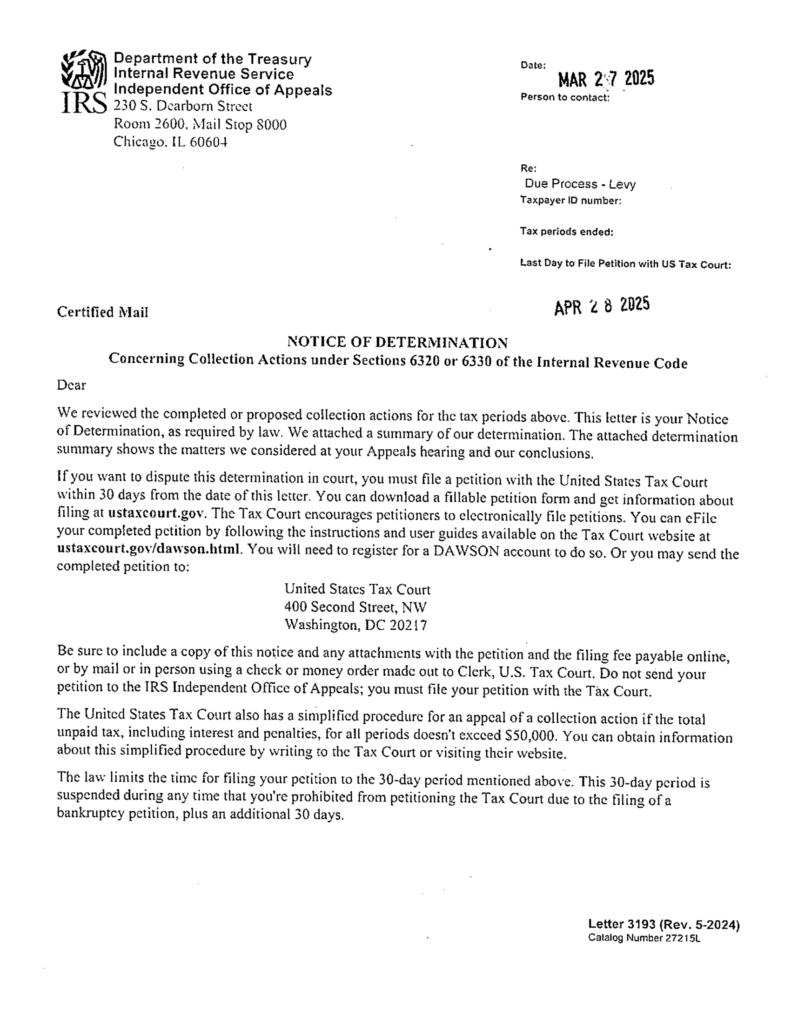
Receiving the Notice of Determination means your Collection Due Process Appeal has been closed out and the Levy or Lien against you is now sustained. This means the IRS can now proceed with enforcement action. This can be a big deal if your case is assigned to a Revenue Officer as they now have full enforcement capabilities against your bank accounts, wages, and possibly assets.
Why Did the IRS Issue a Notice of Determination?
The reason the IRS issued a Notices of Determination is because you could not reach resolution with an IRS Settlement Officer with regards to your Collection Due Process Hearing. Chronologically it typically would go:
- You requested a Collection Due Process hearing to dispute and IRS lien or levy notice. This can be in response to an IRS LT11 or 1058.
- You had a meeting with a Settlement Officer, and disclosed financials with IRS Form 433-A to propose an installment agreement or non-collectible status.
- No agreement was reached. Possibly because the Settlement Officer did not allow your expenses and the offered monthly payment did not meet your current cash flow.
After you have not reached resolution, the Settlement Officer will issue the Notice of Determination.
What to Do Once You Receive the Notice of Determination.
First, carefully review the NOD. The Settlement Officer will verify that they complied with administrative procedures and state how they reached their decision. Be careful, the NOD is written from the Settlement Officer’s perspective. They do not include our side of the story. Our side may include facts that were not documented in the IRS case notes.
Some reasons why you may disagree with the Notice of Determination are:
- The Settlement Officer did not consider your financial situation. The Internal Revenue Manual, the handbook on which IRS employees rely on to make decisions, is a expansive manual that covers many rules and exceptions. It may be that the IRS did not follow its own rules and regulations it has listed in their manual. For example, on exemption in the IRM called the “six year rule” allows you to claim the maximum on your expenses such as, student loans and credit cards as long as the liability will be paid back within six years.
- The IRS may have a procedural or administrative error in your case. Although it is not common, the IRS does make errors in their cases. I have seen the IRS fail to receive faxes proposing resolution or new hearing dates. I have also seen the IRS issue Final Notices of Intent to Levy when they were prohibited from doing so.
- You were told you did not qualify for certain relief when you did. You may be told that you do not qualify for an innocent spouse claim or non-collectible status when your documents and facts prove that you do. Sometimes, your profit and loss or bank statements do not paint a full picture of your actual cash flow.
If we disagree with the decision, we can move to our next step, petitioning to the United States Tax Court.
How to Petition to the United States Tax Court
First, and by far the most important factor to keep in mind is that the petition to Tax Court is statutorily set at a 30-day window. The Court, the IRS, and even Attorneys cannot extend this window to file, so it is crucial that a petition is filed within this time frame. Additionally, filing a petition in tax court generally suspends levy and enforcement action during litigation.
The Tax Court makes filing straightforward. They offer starting and filing our Petition online via the Tax Court website, and service is handled by the Court. The Court has a filing fee of $60. Cases are broken into two different areas, small tax cases (S Cases) where the amount in controversy does not exceed $50,000, and Regular cases.
When we challenge a Notice of Determination the Tax Court, the Court does not re-decide your case from scratch. Instead it reviews the Settlement Officer’s decision under an “abuse of discretion” standard, meaning that the Court will review if the Settlement Officer determinations are arbitrary, capricious, or without sound basis in fact or law. If the Court agrees with us, it remands the case back to Appeals for compliance with its instructions.
For example, a Settlement Officer did not accept a proposed installment agreement because of equity in assets. However, we point out to the Settlement Officer that they are overvaluing your house by not taking the quick sale value of the asset as required in the Internal Revenue Manual. The Settlement Officer disagrees and issues the Notice of Determination. If we petition the Tax Court and they agree with us, the case file is sent back to IRS Appeals with instruction to follow the Internal Revenue Manual and take the quick sale value of the house. The Court does not determine what the equity in the house is, they leave that up to the IRS.
How we Can Help
We regularly represent taxpayers before the IRS Independent Office of Appeals and United States Tax Court.
If you have been struggling to resolve your case with an IRS Settlement Officer, or received a Notice of Determination, we can assist you in resolving your case with the Independent Office of Appeals or, when appropriate, Petitioning Tax Court to seek a remand of your case.